
In a busy warehouse environment, every piece of equipment must be reliable, safe, and efficient. One such essential is a ladder — but not just any ladder. When you choose industrial aluminium ladders, you’re investing in durability, corrosion resistance, and usability. For operations in Cape Town and across South Africa, selecting lightweight ladders Cape Town that still meet safety standards is vital. In this guide, we’ll explore everything you need to know about warehouse safety ladders, the different ladder types, compliance requirements, and how West Coast Suppliers can help you make the right decision.
In fact, about 10% of the text below emphasizes our three focus keywords — industrial aluminium ladders, lightweight ladders Cape Town, warehouse safety ladders — so they’ll be well represented for SEO and relevance.
1. Why Choosing the Right industrial aluminium ladders Matters
1.1 The Role of Ladders in Warehouse Operations
Ladders in a warehouse setting are more than just tools — they are a critical component of daily workflow. From retrieving goods on high shelves, performing inspections, to maintenance work, ladders are used continuously. If the ladder fails — whether by collapse, slippage, or fatigue — it can cause injuries, operational delays, or damage to goods.
1.2 Key Requirements: Durability, Safety, Efficiency
When selecting a ladder for industrial use, you should insist on the following:
- Load capacity and structural strength: The ladder must support the heaviest plausible user weight plus tools or equipment.
- Corrosion resistance: Warehouses, particularly in coastal environments such as Cape Town, may expose equipment to humidity or salt air — aluminium offers excellent corrosion performance.
- Mobility and weight: A ladder that is too heavy becomes cumbersome and less likely to be used correctly; lightweight ladders Cape Town ensures your staff can move them safely.
- Safety features: Slip-resistant rungs, stabilising base rails, locking mechanisms (for extension or multi-purpose ladders), and compliance with safety standards are essential.
- Longevity: The more rugged the ladder, the longer your total cost of ownership will be lower.
1.3 The West Coast Suppliers Advantage
At West Coast Suppliers, we focus on supplying industrial aluminium ladders that balance weight, strength, and safety. We source from reputable manufacturers, and our team can guide you through the selection process. We’re based in Cape Town, so our lightweight ladders Cape Town stock is tailored to your needs, and we understand the local environmental and regulatory context. westcoastsuppliers.co.za+1
2. Types of industrial aluminium ladders: Single, Extension, and Multi-Purpose
Understanding the differences among industrial aluminium ladders types ensures you choose the model best suited to your warehouse tasks.
2.1 Single (Straight) industrial aluminium ladders
Definition & Use Cases
A single ladder is a rigid one-piece ladder that leans against a stable surface (wall, shelving, racking). It is straightforward and often used for lower reach heights — for example, accessing mezzanine levels or shelving up to 3–6m.
Advantages
- Simplicity (no hinge, no sliding parts)
- Lightweight relative to reach
- Fewer moving parts = lower maintenance
Limitations
- You need a stable structure to lean against
- Limited reach depending on height
- No flexibility to convert to other forms
In many warehouses, single ladders are used for routine tasks where the height is moderate. When selecting a single aluminium ladder, ensure the rung spacing, safety feet, and platform options are compatible with your operations.
2.2 Extension industrial aluminium ladders
Definition & Use Cases
An extension industrial aluminium ladders consists of two or more sliding sections. You extend it by pulling the upper sections upward, locking them in place. This is ideal for operations needing higher reach — eg. accessing the top racks, maintenance on high ceilings, or external access.
Advantages
- Greater reach from compact storage size
- Adjustable heights
- Good for both indoor and outdoor use
Challenges & Considerations
- Must ensure locking mechanisms are robust
- Requires stable anchoring or foot placement
- Wind or sway is a greater risk at height
- User training is more important
For warehouse safety industrial aluminium ladders, extension ladders should come with features like auto-lock pawls, rope & pulley systems, and stabiliser bars.
Again at West Coast Suppliers, we stock extension aluminium ladders in different reach classes tailored to industrial use. westcoastsuppliers.co.za+1
2.3 Multi-Purpose (Combination) industrial aluminium ladders
Definition & Use Cases
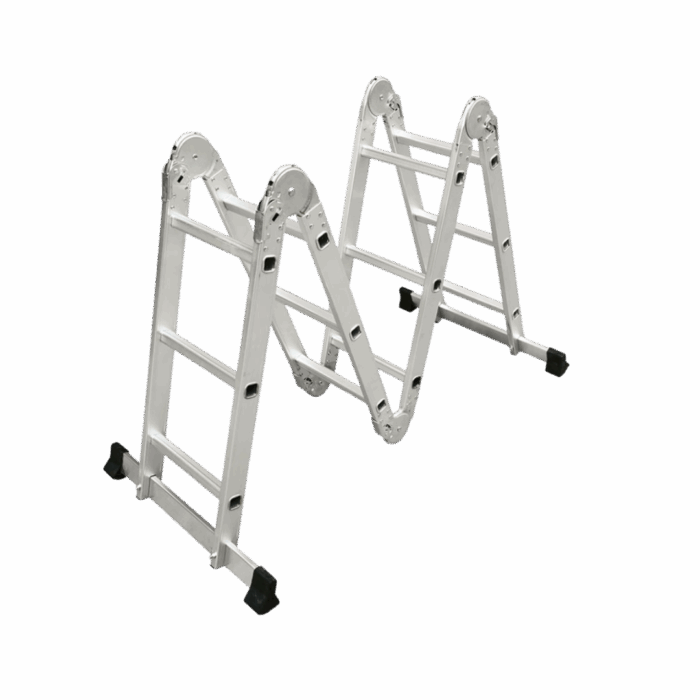
Multi-purpose ladders combine the functionalities of single, extension, step industrial aluminium ladders, and sometimes scaffold platform options. They use hinges or locking joints to reconfigure. This versatility is useful when your warehouse tasks are varied — perhaps requiring both shelving access and temporary elevated work surfaces.
Advantages
- Offers multiple configurations
- Better space economy (one ladder for many tasks)
- Flexibility in different warehouse zones
Challenges & Considerations
- Hinges and locking joints must be very durable
- Slightly heavier due to additional hardware
- Must ensure safe locking in each configuration
- More complex inspection and maintenance
High-quality multi-purpose industrial aluminium ladders are ideal in warehouse environments where flexibility is key — for example, a ladder that converts from a lean industrial aluminium ladders to a platform for lighting maintenance. West Coast Suppliers offers several models in our ladder range to suit these applications. westcoastsuppliers.co.za+1
2.4 Choosing the Right Type industrial aluminium ladders by Warehouse Zone or Task
To help you decide which industrial aluminium ladders type suits which tasks, consider the following:
| Task / Zone | Height Required | Stability Options | Best Ladder Type | Notes |
|---|---|---|---|---|
| Accessing mid-level racking (3–6m) | Moderate | Shelf edges, rails | Single or multi-purpose | A single ladder is often sufficient |
| Reaching high overhead light or mezzanine (≥ 8m) | High | Floor anchoring, stabilisers | Extension ladder | Use stabiliser arms and foot plates |
| Maintenance, signage, long tasks | Variable | Flat surfaces | Multi-purpose ladder | Enables scaffold or platform mode |
| Occasional outdoor warehouse wall tasks | High external reach | Ground conditions, footing | Extension ladder | Choose model rated for outdoor use |
One tip: in a warehouse with mixed needs, combining a single industrial aluminium ladders for routine tasks with one or more extension or multi-purpose industrial aluminium ladders gives operational flexibility.
3. Safety, Compliance, and Best Practices for Warehouse Ladders
Selecting the right ladder is only half the job — you must ensure safety, proper use, and compliance. Here we cover guidelines and strategies to keep your team safe and your operations lawful.
3.1 South African Occupational Health & Safety (OHS) Requirements
While OHS legislation may not specify every ladder detail, it imposes general responsibilities:
- The employer must ensure equipment is safe and maintained.
- Workers must be trained in correct use.
- Regular inspections and records must be kept.
- The risk of working at height must be assessed, and control measures (e.g. fall protection) must be in place.
In addition, ladder manufacturers often comply with local and international standards (e.g. SANS, ISO) — you should check for certifications and safety marks when you purchase warehouse safety ladders.
3.2 Ladder Inspection & Maintenance
Routine inspections are non-negotiable. Key things to check:
- Rungs and side rails: Dents, bends, cracks, corrosion
- Joints, locks, hinges: Smooth functioning, wear
- Feet / base plates: Grip condition, anti-slip pads
- Rope, pulleys (for extension ladders): Fraying, wear
- Labels and load ratings: Legibility and correctness
Create a schedule (weekly, monthly, quarterly) and log findings. Any ladder failing inspection should be quarantined until repaired or replaced.
3.3 Correct Usage Techniques
Key guidelines for ladder safety:
- Set the ladder correctly: The 4:1 rule (1 unit out for every 4 units up) applies to extension ladders.
- Secure the base and top: Use stabilisers or anchor points as needed.
- Face the ladder: Always climb facing the rungs.
- Maintain three points of contact: Two feet + one hand or two hands + one foot.
- Don’t overreach: Move the ladder instead of leaning sideways.
- Limit the load: Don’t exceed the rated capacity including tools.
- Wear suitable footwear: Slip-resistant, flat soles.
- Use fall protection where needed: Harnesses, guard rails, scaffolding alternatives.
3.4 Training & Standard Operating Procedures (SOPs)
Having formal SOPs ensures consistency and reduces errors:
- Define who may use ladders (competent persons only).
- Mandate pre-use inspection.
- Prohibit ladder use under certain conditions (wet floors, wind, uneven ground).
- Define safe setup procedures and fall protection requirements.
- Enforce reporting and documenting incidents or near-misses.
3.5 Ladder Storage & Handling
Even when unused, ladders must be stored properly:
- Keep ladders off damp floors to prevent corrosion.
- Store horizontally on racks or hooks to avoid warping.
- Secure them so they cannot fall over.
- Label each ladder with its ID, inspection date, and next inspection.
When transporting ladders inside the warehouse, ensure they don’t obstruct aisles or pose tripping hazards.
4. How to Choose the Right Aluminium Ladder: A Step-by-Step Checklist
Here’s a stepwise approach to ensure you pick the best ladder for your warehouse environment, with emphasis on industrial aluminium ladders, lightweight ladders Cape Town, and warehouse safety ladders.
Step 1: Assess Your Operational Needs

- How high will your staff need to reach?
- How often will the ladder be moved?
- Will it be used indoors or outdoors?
- Is flexibility (multiple configurations) necessary?
- What environmental conditions (humidity, salt air) exist?
Step 2: Determine Load Requirements
Factor in:
- Worker weight + tools/equipment
- Safety margin (e.g. 1.5× or 2× expected load)
- Consider duty ratings (Type 1, Type IA, etc.)
Step 3: Choose Ladder Type(s)
Use the mapping from section 2. Match tasks to ladder types (single, extension, multi-purpose). If multiple ladder types are needed, balance cost vs utility.
Step 4: Examine Safety Features & Certification
Ensure the ladder includes:
- Slip-resistant rungs
- Safety feet / rubber pads
- Locking mechanisms (for extension or folding)
- Stabiliser bars or outriggers
- Certification or compliance with recognised standards
Step 5: Check Material & Build Quality
- Aluminium alloy grade (6061, 6063, etc.)
- Weld quality or extrusion strength
- Corrosion protection (anodised finish, powder coating)
- Reinforced rails where needed
Step 6: Review Manufacturer Support & After-sales Service
Good suppliers — like West Coast Suppliers — offer:
- Technical advice and sizing support
- Spare parts (feet, locks)
- Warranty and repair services
- On-site support for large installations
Step 7: Order & Implementation

Once you order, plan for:
- Delivery logistics (size, freight, handling)
- Ladder labelling and asset tagging
- Training for staff
- Integration with maintenance schedules
5. Why West Coast Suppliers Is Your Ideal Partner
5.1 Industry Experience & Focus
West Coast Suppliers has over 30 years’ experience in the warehouse equipment and industrial supply sector. westcoastsuppliers.co.za We understand the needs of South African operations, particularly in the Western Cape region. You benefit from decades of product selection insight.
5.2 Broad Product Range
On the site, West Coast Suppliers offers a variety of ladders — from basic aluminium ladders to scaffolding, trolleys, material handling and more. westcoastsuppliers.co.za+1 If your warehouse shifts, you can source complementary access, lifting, and handling equipment from the same supplier.
5.3 Local Stock & Support
Because we serve Cape Town directly, our lightweight ladders Cape Town inventory is tuned to your environment. We can provide quicker delivery, on-site consultation, and support compared to distant suppliers. westcoastsuppliers.co.za
5.4 Expert Advice
Our technical team can help assess your warehouse zones, recommend ladder types, and assist with compliance. Whether you need a single ladder for daily restock or multiple extension ladders for ceiling maintenance, we guide you.
5.5 Quality Assurance & Warranty
We only stock ladders that meet durability and safety standards. If issues arise, our after-sales support ensures replacement parts or service are available. westcoastsuppliers.co.za
5.6 Full Solution Range
Beyond ladders, West Coast Suppliers also provides scaffolding, trolleys, lifting & handling equipment, and storage solutions. westcoastsuppliers.co.za+1 This holistic offering means your warehouse design and operation can be streamlined.
6. Real-World Examples & Case Scenarios
Here are illustrative examples of how different warehouse settings might deploy industrial aluminium ladders and warehouse safety ladders, with commentary on best practice.
6.1 Medium-Sized Logistics Warehouse in Cape Town
A warehouse running 8,000 m² with racking up to 8m:
- Use a single industrial aluminium ladders for tasks up to 4m (receiving, shelf checks).
- Use extension industrial aluminium ladders for maintenance tasks (lighting, sprinklers).
- For occasional scaffold or multi-level tasks, a multi-purpose ladder converts to a platform.
Staff are trained, and every ladder is inspected weekly. Ladder usage logs and tagging help manage lifecycle. Because West Coast Suppliers stocks these ladder types locally, downtime is minimal.
6.2 Cold Storage / Refrigerated Warehouse
Challenges: condensation, slippery surfaces, variable temperatures.
- Prefer aluminium (resists corrosion); avoid steel.
- Use ladders with extra grip / rubberised feet.
- Ensure storage in a dry zone when not in use.
- Use extension or fixed ladders with extra rigidity, avoiding hinge/joint weakness in cold.
6.3 E-Commerce Fulfillment Center
High throughput, rapid picking cycles, multiple shifts.
- Many lightweight ladders must be moved constantly.
- Use mobile trolleys to transport ladders between zones.
- Use short, stable single ladders for frequent access points.
- Reserve extension or multi-purpose ladders for maintenance staff only.
6.4 Maintenance Contractor Operating Across Warehouses
A contractor visiting multiple warehouse sites must carry adaptable ladders:
- A multi-purpose aluminium ladder provides flexibility across different client layouts.
- Compact folding configuration aids transport.
- Ensure compliance and inspection across sites.
These examples show how ladder choice depends not just on height, but on frequency, mobility, and environmental conditions.
7. FAQs & Common Myths
Q1: Are aluminium ladders safe in electrical environments?
Aluminium is conductive — do not use aluminium ladders near exposed live electrical wires. For such applications, fiberglass or insulated ladders are safer. Use aluminium ladders only in dry, non-electrical zones unless properly isolated.
Q2: Does lighter mean weaker?
Not necessarily. Modern industrial aluminium ladders use high-grade alloys and reinforcements to maintain strength while reducing weight. Always check load ratings, structural design, and certifications.
Q3: Should I replace a ladder if it shows slight damage?
Yes — even small cracks, bends, or hinge play can compromise structural integrity. A ladder showing damage should be removed from service and either repaired (if manufacturer permits) or replaced.
Q4: Can any ladder brand be trusted?
Not all. Always verify certification, manufacturing quality, and supplier reputation. West Coast Suppliers partners with reputable brands, and we inspect stock before delivery.
Q5: How often should ladders be replaced?
There’s no fixed number — it depends on usage, damage, and condition. However, after heavy wear or multiple repairs, replacement is safer than prolonging life. Use inspection logs to guide lifecycle decisions.
8. Summary & Call to Action
Choosing the right ladder is more than selecting a height — it’s about ensuring safety, durability, compliance, and efficiency. In warehouse environments, industrial aluminium ladders give strength and corrosion resistance; lightweight ladders Cape Town enable ease of use locally; and rigorous practices around warehouse safety ladders keep your team safe.
At West Coast Suppliers, we’re more than a supplier — we’re your partner. From technical selection advice to delivery, maintenance, and spares, we back you at every step. If you’re ready to upgrade your ladder fleet, contact us today, request a quote, or book a consultation.
Let us help you elevate safety and productivity — one step at a time.